1. Introduction
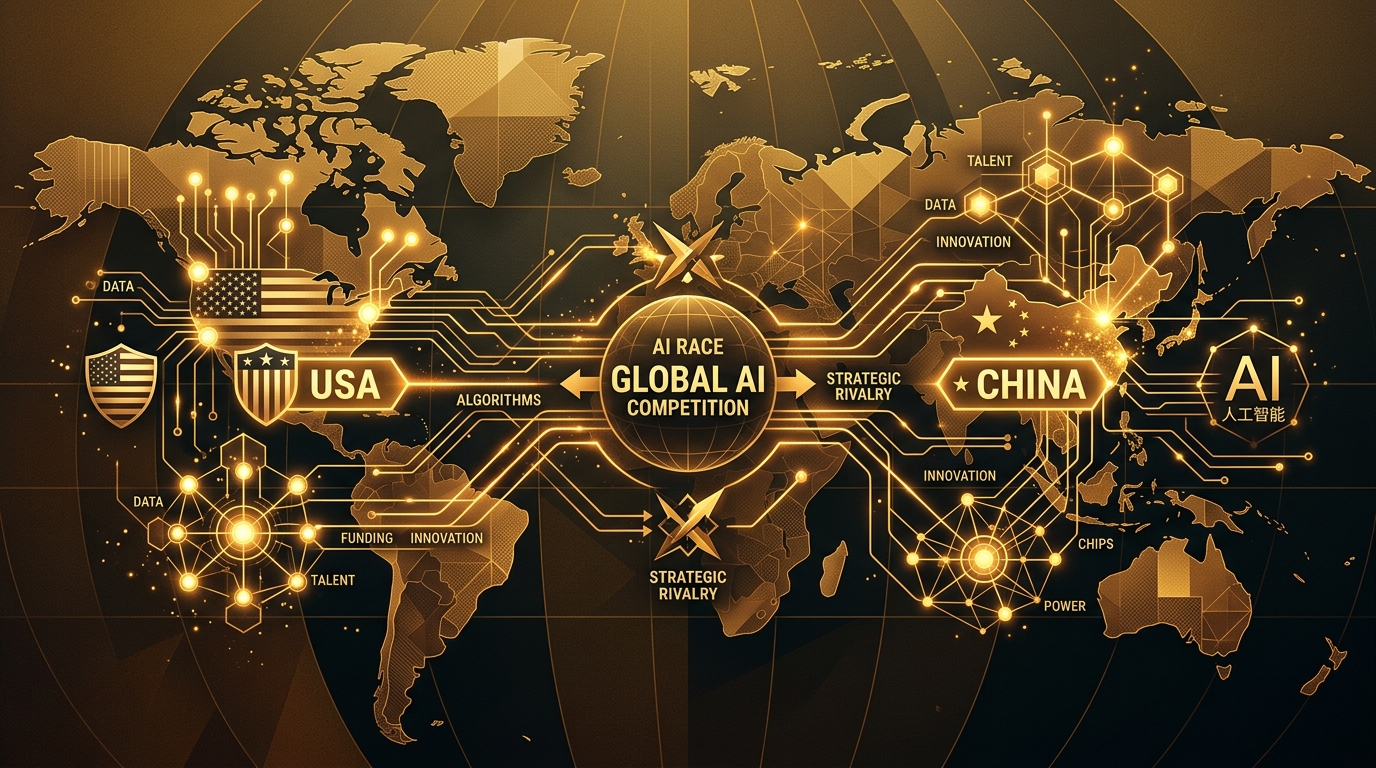
As we cross the median point of the decade, artificial intelligence has solidified its position not merely as an industry multiplier, but as the foundational substrate of 21st-century power. What began as a series of computational breakthroughs in research laboratories has escalated into a defining geopolitical standoff. In 2026, the terminology of international relations has shifted decisively; we are no longer speaking of a trade imbalance or diplomatic posturing. We are witnessing the maturation of the "AI Cold War."
This technological rivalry shares deep structural similarities with the mid-20th-century Space Race between the United States and the Soviet Union. Just as the launch of Sputnik in 1957 or the Apollo landings of 1969 were viewed as existential assertions of ideological and systemic superiority, the release of frontier neural models, sovereign compute superclusters, and advanced semiconductor stacks in 2026 are the modern metrics of global dominance. However, the stakes of the AI Cold War are fundamentally higher. While the Space Race contested physical frontiers, the AI Cold War is a battle over the cognitive infrastructure of human civilization.
The year 2026 represents a critical inflection point in global technological history. The preceding years of exponential parameter growth, hardware stockpiling, and theoretical refinement have converged. The boundaries between commercial software development, national security, and state sovereignty have dissolved. The choices made by policymakers and engineers in Washington and Beijing this year will determine the standards, protocols, and ethical paradigms of the intelligence-driven economy for the next half-century.
2. The Rise of the AI Cold War
The genesis of the current standoff lies in the rapid commercial acceleration of generative models in the early 2020s. In the United States, a highly competitive venture-backed ecosystem led by OpenAI, Google DeepMind, Anthropic, and Microsoft pushed the boundaries of large language models and multimodal agents. This software innovation was facilitated by NVIDIA's absolute dominance in hardware acceleration, providing the compute engine that powered the scaling laws. The American strategy relied on private-sector dynamism, massive capital influx, and an open, international talent pool.
Concurrently, China mounted a massive, coordinated response. Overcoming early setbacks, Chinese technology giants—most notably Huawei, Baidu, Alibaba, and Tencent—along with agile new startups like Moonshot AI and the engineering powerhouse DeepSeek, built robust alternatives. DeepSeek's breakthrough models, combining Mixture-of-Experts (MoE) architectures with unprecedented training cost efficiency, shattered the assumption that massive capital was the only pathway to frontier intelligence.
By 2026, the nature of the competition has underwent a structural shift. The focus has moved from pure algorithmic design to vertical infrastructure control:
* The Chip Stacks: Securing independent pathways to advanced silicon.
* Energy and Grids: Scaling gigawatt-level datacenters to power training runs.
* Geopolitical Alignment: Exporting sovereign AI ecosystems to non-aligned nations.
The software-only era of AI competition has ended; the era of sovereign compute and hard infrastructure has begun.
3. WAIC 2026: China's Declaration of AI Ambition
In July 2026, the World Artificial Intelligence Conference (WAIC) in Shanghai served as the stage for a historic geopolitical statement. For the first time, Chinese President Xi Jinping attended the conference in person, signaling to global observers that artificial intelligence is now central to the nation's strategic doctrine.
At the conference, China formally proposed the Global AI Common Good Framework. This diplomatic and governance initiative seeks to position China as the leader in equitable AI distribution. The framework emphasizes:
1. Sovereign Data Rights: Rebuffing Western models trained on globally scraped data without national consent.
2. Multilateral Infrastructure Support: Providing developing nations with subsidized hardware, local model hosting, and training resources.
3. De-weaponization Restrictions: Establishing strict bans on AI in autonomous weapon decision-making chains, contrasting with American military integrations.
This diplomatic pivot is a calculated alternative to the U.S.-led, safety-first governance models. By framing AI as a global public good rather than an existential risk that must be restricted, Beijing is building strong technological alliances across Southeast Asia, Africa, and Latin America. Through bilateral agreements, China is deploying localized telecommunications networks paired with native language AI assistants, creating a parallel, Chinese-aligned digital infrastructure across the Global South.
4. Huawei's Comeback
Perhaps the most significant industrial story of the AI Cold War is the resurgence of Huawei. Once crippled by Western technology bans and restricted access to TSMC's manufacturing nodes, the Shenzhen-based conglomerate has restructured its operations to become the cornerstone of China's sovereign AI stack.
Huawei’s Ascend AI ecosystem has emerged as the principal domestic competitor to NVIDIA's accelerators. In early 2026, Huawei officially announced the Atlas 950 SuperPoD, a massive compute cluster architecture powered entirely by domestic silicon. The Atlas 950 utilizes advanced domestic packaging techniques to bypass lithography limitations, linking multi-chip modules with high-bandwidth interconnects that rival Western throughput.
While NVIDIA remains the global standard, Huawei's CANN (Compute Architecture for Neural Networks) software layer has matured, offering automatic translation of PyTorch and TensorFlow code to run natively on Ascend processors. This has dramatically lowered the migration barrier for Chinese enterprises. While American systems still lead in raw energy efficiency and single-card training speeds, China's aggressive investment in domestic semiconductor supply chains has made hardware self-reliance an operational reality.
Below is a comparative breakdown of the two competing AI blocks in 2026:
| Category | United States (USA) | China |
|---|---|---|
| Leading Chip | NVIDIA Blackwell / Ultra | Huawei Ascend 920 Series |
| Key AI Players | OpenAI, Anthropic, Google, Microsoft | DeepSeek, Huawei, Moonshot AI, Baidu |
| Strategic Focus | Algorithmic Frontiers & AGI | Scale, Efficiency & Sovereign Infrastructure |
| Government Role | Moderate (Subsidies & Export Bans) | Extensive (National Integration & Subsidized Compute) |
| Ecosystem Style | Proprietary & Commercial APIs | Highly Aggressive Open-Source & Open-Weights |
| Manufacturing | Outsourced (TSMC Taiwan / US Fabs) | Domestic Expansion (SMIC / Local Packaging) |
5. The Chip War
The battle for technological supremacy is fought on the microscopic level. Semiconductors have officially become the "oil" of the digital age—the resource for which superpowers will restructure international trade, form alliances, and risk economic warfare.
The United States has maintained strict export controls, tightening restrictions on advanced semiconductor manufacturing equipment, extreme ultraviolet (EUV) lithography systems, and high-performance computing chips. The goal is simple: isolate China from the global silicon supply chain to prevent the development of military-grade AI applications and frontier foundation models.
However, this containment policy has triggered a massive domestic counter-offensive. China has channeled hundreds of billions of dollars into domestic semiconductor research and fabrication. Through Smarter Lithography projects and advanced multi-chiplet packaging, Chinese fabs are producing high-yield AI accelerators without relying on Western-controlled supply chains.
At the center of this tension is Taiwan. TSMC (Taiwan Semiconductor Manufacturing Company) remains the primary fabricator of the world's most advanced AI chips, including NVIDIA’s Blackwell architecture. The strategic importance of the Taiwan Strait cannot be overstated; any disruption to this single node of global manufacturing would instantly freeze Western AI development. Consequently, both Washington and Beijing are racing to build domestic alternatives—Washington through the CHIPS Act and domestic fab construction, and Beijing through systemic supply-chain independence.
6. AI Philosophies: America vs China
The AI Cold War is not merely a race of computational power; it is a clash of fundamental philosophies regarding the role of intelligence in society.
The United States: Private Innovation and AGI Ambition
The American ecosystem is driven by private enterprise, venture capital, and a cultural obsession with achieving Artificial General Intelligence (AGI).
* Market Dynamics: Startups raise tens of billions of dollars, competing in a hyper-capitalist market to release the next paradigm-shifting model.
* Safety Paradigms: Silicon Valley is deeply divided by ideological debates surrounding AI alignment, existential risk, and regulatory capture.
* Talent Attraction: The U.S. relies on its prestige and open academic institutions to draw the best mathematical minds from across the globe.
China: State Integration and Cost-Efficient Scale
In contrast, China's AI strategy is deeply integrated with state planning and industrial application.
* Industrial Alignment: Rather than focusing purely on abstract, text-based reasoning, Chinese developers prioritize physical AI: robotics, smart manufacturing, port automation, and agricultural monitoring.
* Open-Source Proliferation: To counter American proprietary APIs, Chinese firms like DeepSeek have adopted an aggressive open-source and open-weight model, distributing advanced capabilities globally to commoditize American software margins.
* Sovereign Alignment: Models are trained with a strict focus on social cohesion, public safety, and alignment with national values, avoiding the polarizing cultural debates that frequently stall Western deployments.
7. The Military Dimension
Behind the commercial and diplomatic maneuvers lies a quiet, high-stakes military integration. Artificial intelligence is rapidly becoming the nuclear technology of the 21st century—a dual-use asset that fundamentally alters the nature of deterrence and warfare.
In 2026, military doctrines on both sides have integrated AI across the entire chain of command:
* Autonomous Swarm Intelligence: Mass-produced, low-cost drone swarms capable of coordinated reconnaissance and target acquisition without constant human pilot links.
* Predictive Battlespace Management: AI systems analyzing satellite feeds, communications, and logistical streams to predict enemy movements hours before they occur.
* Offensive Cyber Operations: Autonomous agent networks capable of identifying zero-day vulnerabilities, writing exploit code, and deploying payloads at machine speeds.
The risk of an uncontrolled AI arms race is high. Unlike nuclear weapons, which require massive enrichment facilities and physical footprints, AI models are digital, infinitely replicable, and easily hidden. The lack of international verification mechanisms makes bilateral arms-control treaties for intelligence systems practically impossible to enforce, creating a highly volatile strategic environment.
8. Global Implications
The polarization of the AI landscape is forcing non-aligned nations to choose between two technological spheres of influence.
The Western Alignment
Europe, Japan, South Korea, and Australia remain closely tied to the American AI ecosystem. While Europe has implemented strict regulatory frameworks (the EU AI Act), its industries remain dependent on American hyperscalers (Microsoft Azure, AWS, Google Cloud) and proprietary models for commercial productivity.
The Chinese Technological Silk Road
Dozens of nations across Southeast Asia, Central Asia, and Africa are actively adopting the Chinese AI model. Faced with the high costs and strict regulatory conditions of Western software, these countries find China's open-weights models and subsidized Huawei-built datacenters highly attractive. This digital infrastructure creates long-term technological dependencies, as local developers are trained on Chinese APIs and database architectures.
The Non-Aligned Innovators
India is emerging as a unique player, building sovereign digital infrastructure (like India Stack) and refusing to align exclusively with either camp. By leveraging open-source models from both the U.S. and China, India is developing localized, highly efficient models tailored to its massive domestic market, positioning itself as a key independent hub.
9. Who Is Winning in 2026?
Determining the leader of the AI Cold War in 2026 requires looking beyond simple benchmarks. The two superpowers lead in different aspects of the technology stack:
- The U.S. Lead in Frontier Science: In terms of raw cognitive capabilities, multi-modal reasoning, and foundational research breakthroughs, American labs (OpenAI, DeepMind) maintain a 6-to-12 month lead. The venture capital engine and compute budgets in Silicon Valley remain unmatched.
- China's Lead in Real-World Implementation: China leads in the deployment of AI across physical systems. From automated container terminals to smart grid distribution and industrial manufacturing, China translates AI models into productivity gains faster than the West.
- The Cost Efficiency Revolution: Through models like DeepSeek, China has demonstrated that it can match or exceed Western model performances at a fraction of the training and inference cost, neutralizing the advantage of America's massive financial capital.
The contest remains highly fluid. America holds the high ground in advanced silicon design and foundational science, while China dominates in manufacturing scale, self-reliance, and physical deployment.
10. Looking Toward 2030
As we look toward the end of the decade, the trajectory of the AI Cold War points toward a permanently bifurcated world. By 2030, the global economy will likely run on two completely separate stacks of technology: distinct hardware architectures, separate fiber-optic layouts, divergent data governance laws, and opposing ideological models.
The race toward AGI will continue to accelerate, but the definition of intelligence itself may splinter. The West may build highly autonomous, agentic systems focused on knowledge creation and commercial services, while China develops deeply integrated cyber-physical networks designed to optimize state machinery and industrial output.
"By 2030, humanity may not be asking whether AI changed the world, but whether the world changed because of who controlled AI."
11. Conclusion
The technological standoff of 2026 is not a temporary trade dispute; it is the opening chapter of a long-term competition over the future of human capability. The choices made by this generation of developers, researchers, and political leaders will echo for decades.
"The 20th century was defined by oil, nuclear power, and space exploration. The 21st century may ultimately be remembered for a different race altogether—the race to build intelligence itself."
Key Takeaways
- Geopolitical Split: The AI landscape in 2026 is defined by a deep technological divide between the US-backed commercial ecosystem and China's state-supported, open-weight framework.
- Infrastructure over Software: The focus of the AI Cold War has shifted from algorithm design to physical assets: semiconductor fabrication, energy grids, and sovereign compute clusters.
- Sovereign Hardware Rise: Despite Western sanctions, Huawei's Atlas 950 SuperPoD and domestic Ascend ecosystem have established China's independent compute hardware pipeline.
- Global South Alignment: China's diplomatic strategy of providing open-weights models and subsidized infrastructure is creating parallel digital ecosystems in developing nations.
- Physical Deployment: While the U.S. maintains the lead in advanced foundation research and AGI exploration, China dominates in practical industrial, robotic, and infrastructure applications.

No comments:
Leave a Comment